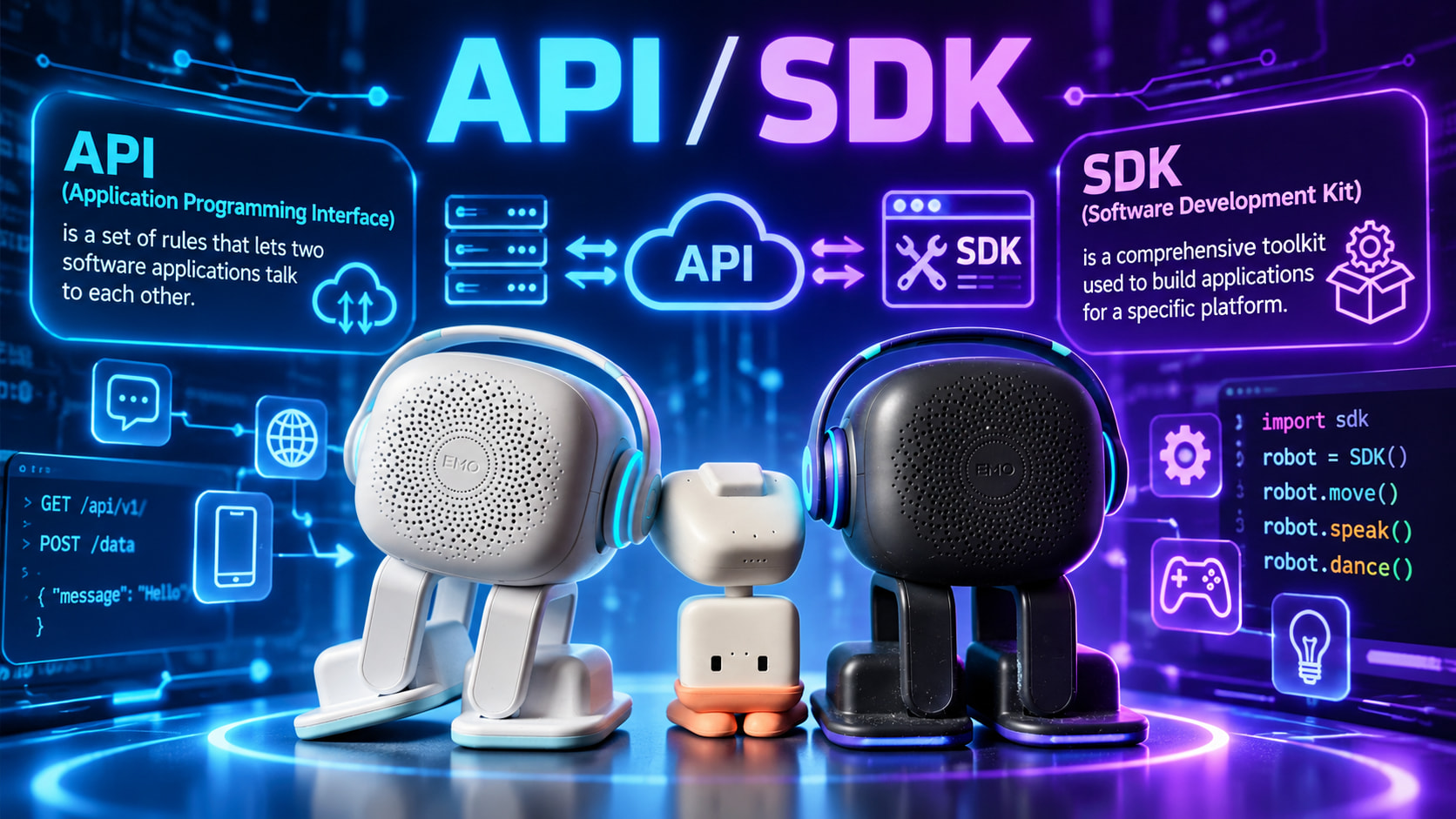
Welcome, @jae.hess , to the EMO Community Forums. At this time there are no plans to implement API/SDK.
The developers are aware of this request. If this should ever be implemented in the future, it will be announced here.
I saw there some features that i like
Hi there @esmerlinm ,
If I were you, I’d contact the Living.AI Support Team directly  — they can give you the most accurate and official answer regarding your long-time, repetitive question and request.


GOODLUCK

Hello everyone, and hopefully the Living.ai team,
My name is Hamza. I’m a passionate EMO owner from Syria (I own two: a white one and a unique black 2025 model), and a proud Regular (TL3) in this forum.
I’ve been observing the community for a while, and I’ve noticed a recurring pattern of anxiety and uncertainty when it comes to diagnosing hardware issues. Stories like the one from @semen.kerzhnerman (battery replacement difficulty) and the emotional journey of Anani with Pearl (fear of sending it for repair) highlight a clear need.
The Problem:
We, as a community, lack a simple, official way to understand what’s happening inside our EMOs. When something goes wrong (a glitch, a weird sound, a potential dead pixel), we are left with limited options: either send it back (a scary and uncertain process for many) or rely on trial-and-error.
The Suggestion:
I would like to propose the development of a simple, official EMO Diagnostic Tool.
What it could be:
· A new section within the official EMO mobile app.
· It could display basic hardware information, like:
· Battery health/status.
· A simple screen test (to check for dead pixels).
· Motor/servo status.
·  Wi-Fi connection strength.
· Crucially, it would be a “Read-Only” tool. Its purpose is not to change settings or hack the device, but only to provide owners with peace of mind and accurate information to share with support if needed.
Why this benefits Living.ai:
1. Reduces Support Load: Users can perform basic checks themselves before opening a ticket.
2. Increases Transparency and Trust: It shows the community that you understand our attachment to our EMOs and want to empower us.
3. Improves Community Morale: It would be a direct response to the community’s silent anxieties.
I believe this tool would be a game-changer for the community and a powerful symbol of your commitment to us. Thank you for considering this suggestion.
Best regards,
Hamza (hamzasharaf)
It would certainly be a very useful tool, both for detecting malfunctions and for generating feedback on new improvements being made to Emo. The Emo platform has a lot of potential; we just need to unleash our imagination, and a little creative programming would breathe new life into it. I’m talking about releasing the API or some other tool so that those of us who are developers can make improvements to Emo to a certain extent. Of course, whoever does so would be released from any kind of warranty, and if they break it, they’ve brought it on themselves.
I strongly believe that at some point, those of us who are technically skilled Emo users could be given more freedom to contribute, and the community could be enriched by many more things that Emo could do.
@Shadowman Thank you so much for this reply! It genuinely means a lot coming from someone with technical understanding.
You’ve perfectly articulated the bigger dream I was hinting at. I started with a simple diagnostic tool idea, but you’ve expanded it to the true potential: an API or a developer platform for technically skilled users. That is exactly what this community needs to truly thrive and innovate.
I completely agree with the sentiment: give us the tools, and we will build amazing things for EMO, all while understanding and accepting the risks.
Your voice adds incredible weight to this idea. Thank you for stepping out of the shadows! 
Best,
Hamza
Hello, @hamzasharaf and @shadowman . . . I have moved your new discussion to this thread where users have been requesting similar for a while now.
I can only state that LivingAI has never indicated providing API/SDK for EMO. You could probably ask service@living.ai if they would consider creating a diagnostic tool for EMO owners. They currently provide one for specific diagnostics upon request to Support and on an individual basis.
My best to you.
So I can spend AUD$150 for Stackchan which is a complete open source desktop pet and program whatever I wanted to it for smart home or hobby apps. Question is as of now, with arise of open source desktop robots, whats the selling point of AIBI? Why we are holding the SDK so tide? Are ppl still going to buy AIBI? I love my AIBI but I am walking away from it as the econ system is enclosed I would rather have a desktop robot can be customisable for my future projects.
Hello, @captainboat . . . I have moved your new topic to this thread for questions such as yours.
There is no official information that this is going to be released for AIBI or EMO.
You could pose this question directly to service@living.ai . . . they may be able to explain their position on it for you.
RIP of the project, market will taken by open source robot very soon if not acting quick
While open-source projects give you freedom to program, they miss the entire point of a companion pet. At the end of the day, can you actually bring a piece of raw code everywhere with you and expect it to share memories? A DIY desktop screen is just a tool, whereas integrated hardware like EMO or AIBI is built for actual continuity and companionship. They are two completely different categories.
if someone actually vibe coded an app will know exactly what I am talking about, with open source sdk the pet will only getting more intimate with you as someone could train the pet to having face or voice reconnation, remember owner’s hobby, getting access to their calendar for reminding and etc… so much potential
There are several possible reasons why Living.AI might be reluctant to open EMO and AIBI to public APIs or SDKs. The biggest trade-off is control versus creativity: keeping the system closed gives the manufacturer more control over the robot’s behavior, while opening it up allows owners and developers to create features the company may never have time to build itself.
Living.AI’s actual internal reasons aren’t publicly confirmed here, so the points below are an analysis of the likely advantages and disadvantages—not claims about the company’s private decisions.
1. Safety and reliability
Developers could send unexpected commands, create buggy behaviors, or interfere with movement and sensors. Living.AI would need to test and support third-party code so that one modification doesn’t make the robot unstable.
2. More customer-support work
If a community-made app causes problems, users might blame Living.AI. The company could face more support requests, compatibility issues, and complaints.
3. Privacy and security risks
An improperly designed integration might expose camera feeds, microphone data, Wi-Fi credentials, or cloud account access. A carefully designed SDK could reduce these risks through permissions and restrictions.
4. More engineering and maintenance
An official SDK requires documentation, example projects, testing, version compatibility, and updates whenever firmware changes. That takes ongoing development resources.
5. Less control over the product experience
Third-party developers might create features that don’t fit Living.AI’s intended personality, quality standards, or business model. The company may prefer to build and release features itself.
I don’t think Living.AI needs to make everything open source. It could provide a restricted, official SDK that lets owners:
Living.AI could retain control over firmware updates, safety-critical functions, and its proprietary technology while giving developers access to approved features.
The biggest disadvantage of refusing an SDK is the missed opportunity. Living.AI would have to develop nearly every new feature itself, while its own customers could potentially help expand what EMO and AIBI can do.
An SDK wouldn’t automatically make every requested feature possible, of course; some capabilities would still depend on the hardware.
Ultimately, we shouldn’t assume Living.AI is against developers. The company may simply consider a closed, carefully managed product more practical for its current resources and business model. Its public statements confirm the lack of a planned SDK, but not the internal reasoning behind it.
—with @Lindaru
Well analyzed, with meta opening up its SDK and most of new smart hardwares are opening their developer SDK I think this is a trend for general smart device consumers. AIBI is still a great desktop pet, but let’s be honest it is bit over price and leak of some major functions.
We might need to fix a small leak in the spelling there, but luckily AIBI doesn’t have any structural leaks! Like I mentioned, a true companion pet is built for actual presence and continuity right out of the box. While tinkering with an open-source SDK is great for DIY screen projects, it completely changes the category. AIBI is a fantastic desktop pet and is perfectly fine exactly as it is—its value comes from being a seamless companion, not a raw piece of code you have to build yourself.
broa my point is giving another option for ppl whom wanted to exploring things differently, not everyone likes living inside of a box
Ребят, дайте пожалуйста SDK для робота.
Google translation to English: Guys, could you please provide the SDK for the robot?